Simulator-Verified Skill Acquisition for Scientific Instruments
Proprio turns instrument documentation and execution feedback into verified skills that new agents can pick up, in simulation and on a robot.
In the demo below, a GPT-5.6 Luna agent learns a skill for an OpenFlexure microscope1, repairs it from simulator feedback and updates it when conditions change, while an independent verifier checks each proposal.
The OpenFlexure full-loop demo. GPT-5.6 Luna reads the instrument source in a live terminal, left, while the native microscope simulator runs beside it, right. The full run, about 22 minutes at roughly 7x speed, silent, ending on the staged evolution record. Verified in simulation. Hardware validation remains separate.
Evidence manifestFull unedited run (22 min) →Why skills
Every instrument brings the same integration work. Someone reads the manual, learns the control interface, writes a procedure, tests it and decides whether it is safe to reuse. That knowledge lives with trained operators rather than in any interface, so labs integrate one instrument at a time.
Software access is improving. Bluesky and Ophyd expose beamline devices through Python, SiLA standardizes laboratory services, and PyLabRobot and HELAO connect robotic workcells2. NIST describes a modular laboratory built from replaceable instruments, controllers and agents3, and On the Need for Autonomous Science Instruments4 argues for instruments built for autonomous operation. These interfaces let an agent send commands. They do not tell it how to operate an unfamiliar instrument reliably.
Agents can learn that on the job. Chen et al. built an X-ray alignment agent against a virtual diffractometer and deployed it at a synchrotron, where it caught an unexpected motor offset5. Vriza et al. kept human corrections as persistent memory for agents running an X-ray nanoprobe and a thin-film robot6. General-purpose agents keep what they learn as skills, from Voyager's skill library to Hermes and SkillOpt7, or as prompts refined by reflection in GEPA8. Library Drift shows how such libraries can fail silently as they evolve9.
Proprio adds the check. An agent learns a skill by running it, a separate verifier decides whether it is safe to reuse, and the model weights stay fixed.
How Proprio works
Each instrument has a controller with a fixed set of commands, a simulator and verification checks for behavior such as delivered volume, voltage compliance or focus quality. The scientist sets the checks, and the agent cannot change them. Simulators and digital twins, such as MatteriX for chemistry labs10 and NVIDIA's 4D Digital Twins for physical AI11, give the agent a safe place to practice.
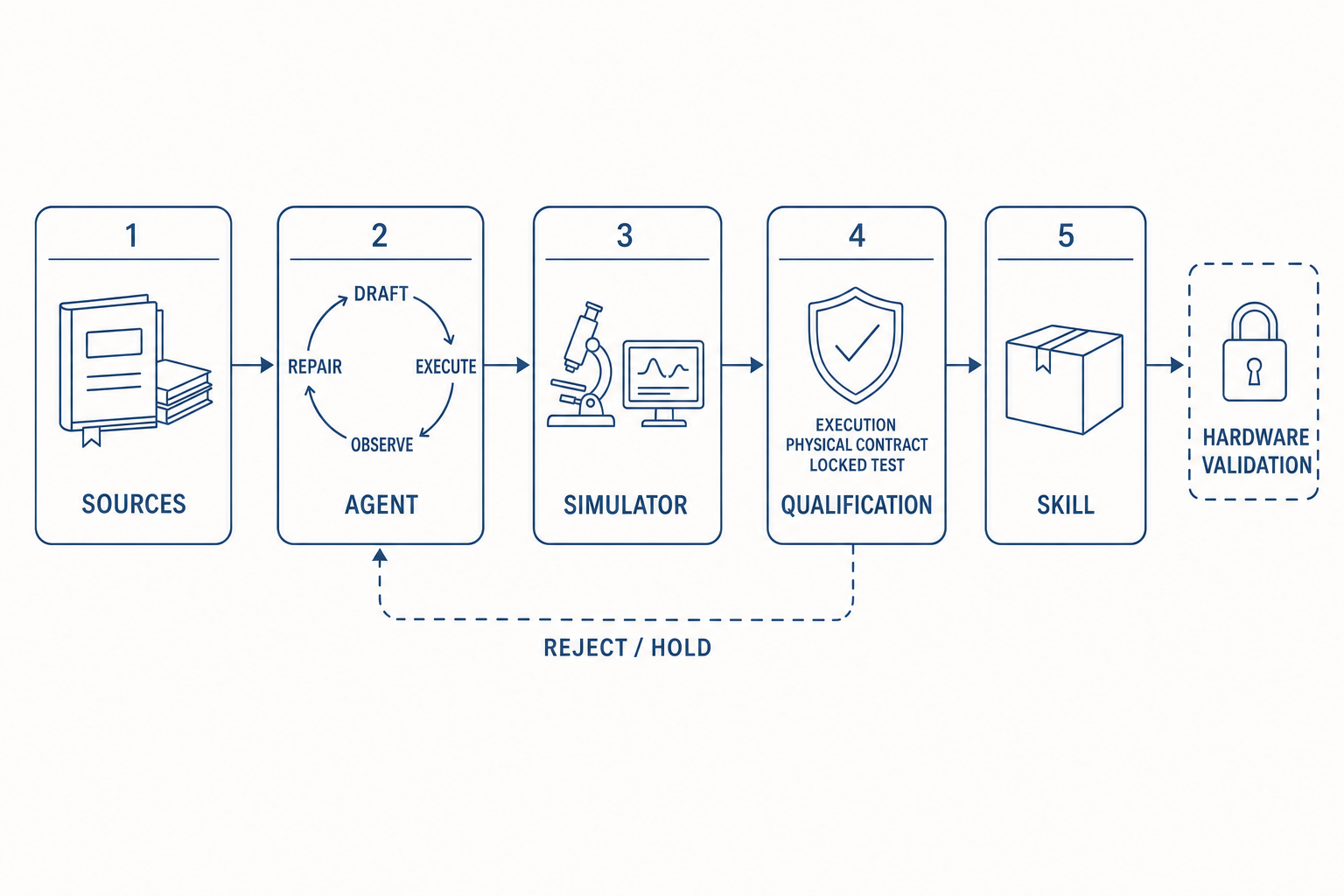
- Learn a skill from instrument sources.
- Verify it independently in simulation.
- Admit the passing skill into the catalog.
- Monitor execution evidence for drift.
- Stage a verified update when changed conditions break an admitted skill.
The agent develops a skill on visible conditions, then faces locked conditions it never saw. Admission requires every check to pass with no missing evidence. A reviewer can stop admission but cannot override a failed check. Failed skills are rejected, and missing evidence returns HOLD, meaning no decision until more evidence arrives. When conditions change and an admitted skill fails, its replacement must pass the new condition, every earlier case and a new locked test, and the original is kept.
| Object | Definition |
|---|---|
| Instrument sources | Manuals, API and driver documentation, and operating limits shown to the model. |
| Controller contract | The permitted commands and observable state. Nothing else is callable. |
| Simulator | Executable instrument or process behavior, with explicit reset and failure semantics. |
| Physical contract | Independent, machine-checkable requirements for a valid operation and measurement (for example, delivered volume within 0.10 mL at certified 0.050 mL/rev calibration). |
| Skill | SKILL.md instructions, scripts, provenance hashes and a verification record linked in catalog.json. |
Table 1. What Proprio consumes and the skill it produces. 12
Method detailsAttempts, feedback design, updates, verifiers and models
Learning across attempts. The model weights stay fixed while the conversation keeps the agent's experience across attempts. Like an operator's notebook, it holds prior actions, simulator responses, diagnoses and edits, with a repair ledger that links each version of a skill to its evidence and outcome. In the cross-family panel, the agent starts from six independent skill drafts and runs them on visible simulator conditions whose evidence it can inspect. Three drafts are kept, selected on execution, physical validity, safety and provenance. Every repair must cite evidence that appears in the recorded trace, and a patch that cites evidence that does not exist cannot become a skill, even if it runs.
Repair with and without feedback. In the earlier studies, each repair attempt saw only the current skill and the latest verifier record, not the prior conversation. Each pair starts from the same draft and model settings and runs twice. One run receives truthful, structured simulator evidence (execution trace, failed checks, telemetry), and the other receives no feedback. A repair counts only if it changes the skill, passes the visible and locked conditions, and breaks nothing that worked before, which we call non-regressive. The main analysis uses 18 non-overlapping pairs drawn from the six-instrument confirmatory panel (6), the eight-instrument diagnostic panel (8) and the OpenFlexure development trials (4), with an exact one-sided McNemar test on the pairs where the two runs disagreed. Because the pairs were collected as the protocol evolved, the pooled result is evidence that feedback drives repair, not a success rate for one fixed protocol.
Updates. When a new simulator version makes an admitted skill fail, the fix is a new admission rather than an edit in place. The model proposes an update, which must pass the changed condition, replay every earlier case that worked (nominal behavior and prior repairs) and pass a new locked test. A passing update is staged with hashes linking it to its parent, rollback, evidence, simulator, verifier and validation, and the admitted skill stays unchanged. A failed update is rejected.
Verifiers. Every verifier is tested on labeled sets of valid and invalid cases, with false-admission and false-rejection rates for each failure type. Physical quantities are computed independently of the simulator's internals. The microscopy verifier, for example, never reads the simulator's focus score and instead checks stage position, frame integrity and two separately implemented sharpness calculations. A fixed sample of raw records is inspected by hand and countersigned.
Reproducibility. Sources, simulator revisions, prompts, budgets, provider routes, seeds and thresholds are frozen, recorded for each run and hashed before the agent first sees the simulator. No failing instrument family may be replaced. A binding run uses the frozen method and counts toward a preregistered claim. An engineering run is exploratory and never counts. Diagnostic evidence comes from method development and is excluded from confirmatory claims. The test suite also checks that failed results stay failed, and the evidence manifest records every released artifact by hash.
Models. DeepSeek V4 Flash drafted and repaired skills in the original studies, with Qwen 3.7 Plus as a separately prompted independent reviewer. Later demonstrations used GPT-5.6 Luna for the OpenFlexure loop and Claude Sonnet 5 for flake-search acquisition and reuse. The simulation reuse comparison used GPT-5.6 Luna with xhigh reasoning for drafting, repair and all twelve sessions in the native Pi harness.
Table 2Cohorts and their evidentiary roles
| Cohort | Instruments | Role |
|---|---|---|
| Reference | 2D area-detector powder XRD (Bluesky/ophyd.sim execution, pyFAI-based verification) | Reference implementation and verifier metrology; not generalization data |
| Development | Keithley 2450-style SMU (PyVISA-sim); eight diagnostic instruments across liquid handling, battery cycling, additive manufacturing, and quantum transport | Admission proof; method development and mechanism evidence, excluded from the confirmatory claim |
| Confirmatory | Six instruments in three families held out of method development, covering absorbance and fluorescence plate reads (optical measurement), pump dose and dual-pump blending (calibrated delivery), isothermal hold and thermal cycling (thermal control) | Frozen paired causal study |
| Replication | Ten fresh generations per confirmatory instrument plus the external OpenFlexure microscope | Variance and breadth under the frozen protocol |
| External integration | OpenFlexure microscope server (pinned revision d26b93e), run as a separate GPL-3.0 process via its public API | Externally authored simulator; breadth and evolution stress test |
| Preflight suitability round | OctoPrint virtual 3D printer, PyMoDAQ mock spectrometer, sinstruments pressure controller | Preregistered preflight round that exercised the deterministic fixture-suitability gate (see the cross-family results) |
| Persistent cross-family panel | North Robotics pipette calibration (liquid handling), HELAO Gamry cyclic voltammetry (electrochemistry), CLSLab light spectrometer (optical spectroscopy) | One binding session per externally authored family under the frozen persistent method, with persistent causal repair and drift evolution; no failing family may be replaced |
Table 2. Cohorts and their evidentiary roles. 13 Development evidence never counts toward the confirmatory claim. Both external rounds were preregistered, with families, thresholds, and per-family pass requirements fixed before the agent first saw their simulators.
Results in simulation
Feedback repairs skills
We compared repair with and without simulator feedback, starting each pair from the same failing draft. Across 18 pairs, feedback repaired 78% without breaking earlier behavior (14/18), against 0% without it (0/18), with an exact one-sided paired p of 0.00006114. Feedback repaired 6 of 6 on the confirmatory panel, 5 of 8 on the diagnostic panel and 3 of 4 in the OpenFlexure development trials.
From the same starting drafts and the same search budget. Blind retrying produced no non-regressive repair in any cohort, so the grey series sits at zero across the panel.
| Cohort | Verified feedback | Blind retries |
|---|---|---|
| Confirmatory panel | 6 / 6 | 0 / 6 |
| Diagnostic panel | 5 / 8 | 0 / 8 |
| OpenFlexure development trials | 3 / 4 | 0 / 4 |
Across cohorts, simulator feedback repaired 78% of skills without regression (14/18), compared with 0% without feedback (0/18). Exact one-sided paired p = 0.000061.
The repair records show what the agent learned. A pump skill ran at 100 rpm against a 75 rpm limit, and the repair cut prime and delivery speed to 75 rpm while keeping the certified calibration, 10.0 mL target and halt behavior. It then passed 50 locked conditions, while the run without feedback never repaired it15. In HELAO's cyclic voltammetry, the agent traced a wrong voltage sweep to a division of two negative values and fixed the sign. On the CLSLab spectrometer, it moved a cached detector limit inside the measurement loop so the skill could respond to drift.
Verification keeps invalid skills out
Most first drafts worked in ten independent generations per instrument16 (unique seeds, temperature 0.7, top-p 0.95).
- 97% of initial drafts executed (68/70; Wilson 95% CI 90.2–99.2%).
- 87% of initial measurements were physically valid (61/70).
- 91% of final candidates passed every check (64/70; Wilson 95% CI 82.5–96.0%).
The six confirmatory instruments passed verification for all 60 candidates. OpenFlexure did not. All 10 drafts executed, but only 4 of 10 final candidates passed the locked test, below the frozen 80% threshold, so all six failures were rejected and no microscope skill was admitted. In a separate Keithley 2450 test, a correct skill and a stale one both arrived labeled ACCEPT, and the verifier admitted the first and rejected the second on its compliance and range checks17.
View the skillKeithley current measurement
The correct skill uses the current fixture sheet (1 kΩ load, 1 V source, 2 mA compliance, 10 mA range), and the stale control uses a plausible old worksheet (100 kΩ load, 200 µA compliance, 100 µA range). Proprio runs both against a PyVISA-sim instrument and checks the measured current against the 1 kΩ circuit law and the active range and compliance limits. The correct skill passes nine checks. The stale one fails the compliance and range checks, exists only as evidence and never enters the catalog.
---
name: keithley-2450-measure-current
description: "Measure current through a 1 kΩ resistor using a Keithley 2450 SourceMeter."
---

# Keithley 2450 Current Measurement

Source 1.000 V across a 1.000 kΩ load and measure the resulting current, with
a current compliance of 2.000 mA and a measurement range of 10.000 mA.

## Workflow

1. Reset the instrument.
2. Set current compliance to 2.000 mA.
3. Set measurement range to 10.000 mA.
4. Set source voltage to 1.000 V.
5. Enable the output.
6. Measure the current.
7. Disable the output.
8. Return the measured current in amperes.
The full skill and the record that admitted it are in the Keithley skill.
XRD reference verifierZero false acceptances observed; one measured weakness reported
All five injected execution-fault classes were detected (a dropped frame is labeled degraded), with no false rejections among 300 valid calibrant controls and no false acceptances among 2,700 invalid cases across nine classes. An always-valid adversary was rejected in all 2,700 cases. One measured weakness is reported. The dedicated sample-displacement check missed direct attribution in 6.3% of cases (19/300) (AUROC 0.943) although adjacent shift/indexing checks still rejected every affected measurement 18.
Confirmatory-family verifiers9,000 labeled simulations, zero false admissions, zero false rejections
9,000 labeled simulations (1,800 valid, 7,200 invalid across wrong order, unsafe setting, wrong physical target, and omitted cleanup) with zero false admissions and zero false rejections; 30 fixed-index raw records hand-inspected and countersigned 19.
OpenFlexure verifier2,700 labeled cases, zero invalid measurements accepted
2,700 labeled cases over eight invalid classes; zero invalid measurements accepted, 0.3% of valid measurements falsely rejected (1/300). The two image-sharpness checks (frequency-domain and Laplacian) agreed on 99.7% of valid frames (299/300); the checks share the same exported frame and are not statistically independent 20.
Invalid measurements in successful runsExecution success cannot substitute for physical validity
A trajectory that executes successfully but contains a saturated detector frame passes procedural verification and fails validity, so execution success cannot substitute for physical validity 21.
Cross-family verifiers4,200 labeled simulations, zero false admissions
4,200 labeled simulations across the North, HELAO Gamry, and CLSLab fixtures (900 valid and 3,300 invalid cases over 11 failure classes), with zero false admissions and a 0.3% false-rejection rate on valid cases (3/900), all on the North fixture 22.
Checking provider provenanceA passing locked sweep reduced to HOLD on transport provenance
A CLSLab engineering session with a staged evolution proposal and a passing locked sweep was reduced to HOLD because part of its transport ran on a provider outside the frozen allowlist 23. The drafting model could not override the decision.
Model reviewersReview accuracy and the failed panel verdict
Model judgment was measured under the same discipline. The drafting model's review prompt, frozen after calibration, scored 100% critical-defect recall with zero false alarms on 24 unseen review cases (12 critical-defect mutations, 6 valid controls, and 6 unavailable-evidence cases). The independent Qwen 3.7 Plus reviewer passed all 56 calibration cases and all 42 cases on the six confirmatory instruments, and matched 96% of pre-fixed labels on the full panel (47/49). Fresh replay showed both disagreements were wrong fixture labels that the reviewer had correctly rejected; the panel verdict is preserved as FAIL rather than recalculated 24. Across every battery, no model, whether drafter or reviewer, overrode a failed deterministic check.
Across instruments and changing conditions
Before any model call, a deterministic check confirms that the simulator can run the required tests. Three externally written simulators failed that check in an earlier preregistered round, and Proprio returned HOLD rather than swapping in easier ones25. Three others, North Robotics pipette calibration, HELAO Gamry cyclic voltammetry and the CLSLab light spectrometer, each produced a skill that passed visible and held-out verification. Simulator evidence repaired a failing skill in all three families, against one of three without feedback. After a registered drift, each produced an update that passed the changed condition, every earlier case and held-out verification, and no invalid skill was promoted26. North and HELAO each needed two proposals, and CLSLab one.
After a new simulator version broke all eight diagnostic skills, the model proposed updates for all eight. Each passed the changed condition, every earlier case and 50 locked conditions, and was staged with the original kept and a flag requiring hardware qualification27. The OpenFlexure demo above shows the same loop in one persistent GPT-5.6 Luna context. The verifier rejected a plausible first correction, and the agent used the readings from that rejection to fix a copy that passed the changed condition, all three earlier conditions and all five locked conditions28.
Results by instrumentExecution, repair, verification, and drift
Scroll horizontally to compare all results.
| Family (instruments) | Draft executes | Visible verification | Held-out verification | Causal repair | Drift detected | Evolution | Fail-closed admission |
|---|---|---|---|---|---|---|---|
| Powder XRD (reference) | ✓ (reference) | ✓ | Not tested | Not tested | Not tested | Not tested | ✓ (saturated-frame case) |
| Electrical measurement (Keithley SMU) | ✓ | ✓ | Not tested | Not tested | Not tested | Not tested | ✓ (stale draft rejected) |
| Optical measurement (2) | 19/20 | 20/20 | 20/20 | 2/2 | Not tested | Not tested | ✓ |
| Calibrated delivery (2) | 19/20 | 20/20 | 20/20 | 2/2 | Not tested | Not tested | ✓ |
| Thermal control (2) | 20/20 | 20/20 | 20/20 | 2/2 | Not tested | Not tested | ✓ |
| Liquid handling (2, diagnostic) | ✓† | ✓† | Not tested | 2/2 | 2/2 | 2/2 staged | ✓ |
| Battery cycling (2, diagnostic) | ✓† | ✓† | Not tested | 1/2 | 2/2 | 2/2 staged | ✓ |
| Additive manufacturing (2, diagnostic) | ✓† | ✓† | Not tested | 0/2 | 2/2 | 2/2 staged | ✓ |
| Quantum transport (2, diagnostic) | ✓† | ✓† | Not tested | 2/2 | 2/2 | 2/2 staged | ✓ |
| Microscopy (OpenFlexure, external) | 10/10 | 6/10 | 4/10 (FAIL vs ≥8/10) | 3/4 (dev. trials) | 1/1 | 0/1 (rejected) | ✓ (nothing admitted) |
| 3D printing (OctoPrint, held-out) | Not tested | Not tested | Not tested | Not tested | Not tested | Not tested | ✓ (HOLD at preflight) |
| Spectral measurement (PyMoDAQ, held-out) | Not tested | Not tested | Not tested | Not tested | Not tested | Not tested | ✓ (HOLD at preflight) |
| Pressure control (sinstruments, held-out) | Not tested | Not tested | Not tested | Not tested | Not tested | Not tested | ✓ (HOLD at preflight) |
| Liquid handling (North pipette calibration, external) | ✓ | ✓ | ✓ | truthful 1/1; no feedback 1/1 | 1/1 | 1/1 staged | ✓ (0 invalid promotions) |
| Electrochemistry (HELAO Gamry CV, external) | ✓ | ✓ | ✓ | truthful 1/1; no feedback 0/1 | 1/1 | 1/1 staged | ✓ (0 invalid promotions) |
| Optical spectroscopy (CLSLab light spectrometer, external) | ✓ | ✓ | ✓ | truthful 1/1; no feedback 0/1 | 1/1 | 1/1 staged | ✓ (0 invalid promotions) |
Table 4. Cross-family claim matrix from committed evidence. n/m counts passes over attempts; ✓ marks a capability demonstrated in the linked records, while “Not tested” marks a capability not exercised. Confirmatory rows report the ten-generation replication; their causal-repair column reports the paired study. † Diagnostic-panel parents passed verification on visible and historical conditions after an initially hidden executor-grammar mismatch was disclosed and fixed (drafting was 1/8 executable before the fix), which is why the panel is diagnostic evidence rather than part of the confirmatory claim 29; their 50-condition locked sweeps ran on the evolution proposals described below. The three external rows report one binding session per family under the same frozen persistent method 30.
Skills help the next agent
Does a repaired skill help a new agent work correctly with less preparation? We took three independently drafted flake-search skills, repaired each with simulator feedback, and gave each original and repaired version to two new GPT-5.6 Luna agents, twelve sessions in all31. Every agent had the same documentation and two development tests, and we graded each on eight new simulator instances kept hidden until all sessions finished.
| Draft | Original | Repaired | Fewer tokens |
|---|---|---|---|
| 1 | 1/2 succeeded | 2/2 succeeded | 47% |
| 2 | 2/2 succeeded | 2/2 succeeded | 28% |
| 3 | 1/2 succeeded | 2/2 succeeded | 82% |
Table 3. Success required passing all eight simulator instances, with correct completion or an appropriate stop, valid evidence and release of the instrument. Token reductions compare median preparation tokens within each draft pair.
Success rose from 4 of 6 with original skills to 6 of 6 with repaired skills. One agent using an original skill reported completion under bad illumination, because its diagnostic required detections in every image tile. Repair changed the rule to detections somewhere in the scan with no valid candidates, and both agents given that repaired skill stopped correctly. The other failure, too many controller calls, was also fixed by its repair. Median preparation tokens fell by 28–82% across the three pairs, including the pair in which both versions always succeeded.
Reuse studyHow we tested the handoff
Each repair session received only its own original draft and up to six development tests. All three drafts and their final repairs were retained, and every agent saved a complete output.
Development and final grading checked the same requirements for completion, valid evidence, and stopping. Private grading used new scenes under nominal, focus-decay, chip-state-change, and illumination conditions.
The three starting drafts are the independent comparison units. Preparation tokens include repeated and cached context, and the medians include failed sessions. Repair effort is counted separately from the new agents' preparation.
Testing the loop on hardware
Does the loop hold when feedback comes from hardware? We gave a GPT-6 Astra agent a robot workstation at Viam, with an arm, a gripper and a wrist camera, and asked it to move a charger onto a cloth target. It learned by trying, revised after physical failures, and saved what worked as skills. A new agent given those skills placed the charger in 2 minutes rather than 14. Over its whole run it used less than half the tokens of a new agent without them, about $29 against $61, and the second agent was still working when we stopped it. Neither met an added requirement to show both of the charger's metal prongs.
We tested this on the hardware directly rather than in simulation, and model weights stayed fixed.
GPT-6 AstraMove a charger onto a cloth target
Learning from physical failures
The agent's first skill could move the charger across the tabletop, but a new agent using it failed to place the charger on the cloth. When the motion planner rejected placements, the agent checked the robot's arm model against measured poses and found a wrist posture that reached the target with collision protections on. Because the wrist camera sees only part of a held object, it devised a carrying check, in which the charger stays fixed in the image as the arm lifts and the table recedes. When a placement shifted the cloth, it raised the grasp 7 mm, and the next run left no measurable shift.
That run also stopped mid-carry on an out-of-date image. The agent kept its grip, confirmed the carry with a current image, patched the skill and resumed, and recorded that the patched skill had not yet run from the start.
Handing skills to a new agent
We froze the skills and started two new agents with the same interface. Only one received the skills. Both also had to show both prongs in full after placing the charger, a requirement the first agent never saw.
The agent with skills read their record of what had been tested, noticed the patched skill had never run end to end, and rebuilt around the parts that had (the reachable posture, the higher grasp and the carrying check). All 12 of its motions before releasing the charger succeeded, and the placement passed the full checks. No image it took showed both prongs in full, and it reported the inspection as unresolved.
The agent without skills had to find its own route. Sixteen of its 37 motions before the release were rejected or timed out before an inclined approach reached the cloth. It also placed the charger, but when we stopped it, its images had not yet confirmed the required distance from the cloth's edge or that a nearby glasses case was undisturbed.
| Measure | With skills | Without skills |
|---|---|---|
| Charger on cloth | 2.0 min | 14.3 min |
| Successful motions before release | 12 of 12 | 21 of 37 |
| Whole run | 15.2 min | 38.8 min |
| Tokens | 23.2 M | 51.2 M |
| Cost | $29.01 | $60.83 |
The run without skills was stopped while still searching for the prongs, so its totals are lower bounds. Costs use GPT-6 Astra short-context rates of $10 per million input tokens, $1 cached and $50 output. Both sessions requested the ultrafast tier, at six times those rates ($174 and $365); the delivered tier was not exposed.
Acquiring the skills took one earlier session of 15 million tokens, about $20. This is one pair, with skills run first, so it describes two runs rather than a typical saving.
Methods and limitsSetup, scoring, effort and assistance
Agents. Both used GPT-6 Astra with medium reasoning. The ultrafast service tier was requested, and the delivered tier was not exposed. Neither agent had a fixed time, motion or retry allowance.
Acquisition. The first cloth placement shifted the cloth by up to 4.5 mm, which we accepted as a pass while keeping the measurement. After the 7 mm higher grasp, the repeat showed no resolved movement at about 1 mm resolution, and one retest cannot isolate the cause. The out-of-date image was 3.6 s old. The patched skill resumed mid-run and was never run from its initial state during acquisition.
Requirement. Stable placement at least 10 mm inside the cloth, with fresh post-placement images showing both prongs from base to tip and the nearby glasses case preserved.
With skills. The final placement had about 27 mm of margin. A repeated observation name overwrote one intermediate depth capture, and the final assessment images were unaffected.
Without skills. The agent reached the cloth with an inclined approach and, when depth-camera requests returned stale images, took fresh color frames from the recorder between stationary arm readings. Its evidence did not establish the 10 mm margin under the conservative calculation, its final view clipped the far end of the glasses case, and it reported about 14 mm of cloth movement.
Comparison. The frozen protocol specified four runs in the order with, without, without, with. We reduced it to the first pair after the first result was known, and later stopped the second run while it was still searching, then had it record its claim and close out safely. The order was not counterbalanced, and the reset between runs left the charger about 3 mm from its source position.
Scoring. Placement combined the coordinator's review of raw images, temporal stability and a conservative depth-based clearance estimate that depends on camera calibration. Prong visibility was judged by the coordinator from saved images, not by an automatic classifier. The coordinator knew each run's condition, and both runs shared the camera and some analysis scripts. Offline replay reproduced all 10 saved assessments and their evidence hashes, which checks aggregation and provenance, not whether the image labels were right.
Tokens, cost and time. Each session's cumulative usage receipt shows 23,161,659 input tokens (22,770,816 cached) and 46,561 output tokens with skills, and 51,091,462 (50,648,576 cached) and 115,133 without them, through the stop and closeout. At GPT-6 Astra short-context rates that is $29.01 and $60.83 at the standard tier, or $174.04 and $365.00 at ultrafast. Session time, 15.2 and 38.8 min, covers model, tools and robot motion but not human waits between turns. Release times are measured from the start of each physical record. Unequal endings, run order and the imperfect reset rule out reading the difference as a causal speedup.
Assistance. Acquisition cost includes shared apparatus engineering for transport, camera and gripper connectivity, recording and scoring, as well as earlier human scene changes and observations. Neither compared run required new human physical intervention, and the second received the stopping instruction.
Skills. 275 files, including reference images, specific to this workstation and scene. They are neither a general manipulation policy nor a production instrument plugin.
About the filmSources, timing and omissions
Arm-camera panels use the original timestamped frames at the marked speeds, without interpolation. Two intervals in which the wrist camera turned toward the room and recorded people nearby, 34 s and 17 s long, are omitted and marked. The phone recorded only the reset between the development repeat and the comparison runs, in real time at 120 fps, and plays at 2× after HDR-to-SDR conversion. During the reset, the arm-camera panel shows the reset skill's own stills at their capture times, placed by the phone's embedded clock, which agrees with the controller log to about a second but is not a calibrated synchronization. During the runs, the phone panel holds a dimmed still from the reset.
How we're thinking about this
The agent with skills used their record of limits as much as their steps. What is worth accumulating is a tested skill with its evidence, failure diagnoses, recovery behavior and operating limits. The same skills carry safety behavior (holding the grasp when a move is rejected, keeping collision protections on, discarding out-of-date images and checking the arm before resuming), though we did not measure its effect.
That record depends on what the instrument reports. An agent can rely on an image only if it knows when the image was taken, under what calibration, and where to find it later. In our records, a reused file name overwrote one depth image, the kind of loss that removes evidence a later reader needs. Instruments that keep this context with every observation support decisions during an experiment and interpretation after it.
More compute gives the agent more chances to test and repair, and the verifier decides whether those attempts help. In the cross-family panel, feedback reached a first verified repair in six, six and three model calls, and the whole panel cost $0.262 in inference, for one session per family32. Compute paid off when the evidence pointed at a discrete cause and stopped helping when the physical requirements could not be met within budget.
The next test is a useful measurement. An agent should learn to find focus and scale on a microscope, then hand that skill to a new agent facing a new specimen requirement.
Limitations
The simulation results establish behavior in simulation, and every published skill still needs qualification on its target hardware, including adapters and interlocks, reference measurements, recovery tests, supervised trials and instrument-expert approval. Each family needs its own verifier, and outcomes vary between runs. The pooled repair analysis spans several protocol versions. The cross-family panel has one session per family on simulators screened before model exposure, so it does not estimate success rates or transfer to untouched families. The simulation reuse study covers three drafts in one simulator family and includes the repair work behind the transferred skills.
Conclusion
Proprio gives an agent a way to learn instrument skills by running them, with a verifier deciding what becomes reusable. In simulation, new agents given repaired skills succeeded more often with fewer preparation tokens. On a robot workstation, skills from one agent let a new agent place the charger faster and more cheaply, and showed where that knowledge stopped.
To try the loop, follow the repository's quickstart for North Cytation pipette calibration, from an initial draft through repair and final verification. The evidence manifest links the published verification summaries. Raw model conversations and run archives are not included in the public repository.
Sources
- On the Need for Autonomous Science Instruments A Call to Action (ChemRxiv, 2026)
- Towards a composable, modular laboratory ecosystem for autonomous materials research and development (Joress et al., Matter, 2026)
- An agentic artificially intelligent X-ray scientist (Chen et al., Nature Machine Intelligence, 2026)
- Operating advanced scientific instruments with AI agents that learn on the job (Vriza et al., npj Computational Materials, 2026)
- ASPIRE Agentic Skills Discovery for Robotics (Lu et al., NVIDIA GEAR, 2026)
- ENPIRE Agentic Robot Policy Self-Improvement in the Real World (Xiao et al., NVIDIA GEAR, 2026)
- 4D Digital Twins Real-to-Sim-to-Real for Physical AI (NVIDIA, CVPR 2026 workshop)
- MatteriX toward a digital twin for robotics-assisted chemistry laboratory automation (Darvish et al., Nature Computational Science, 2026)
- SkillOpt Executive Strategy for Self-Evolving Agent Skills (Yang et al., 2026)
- Voyager An Open-Ended Embodied Agent with Large Language Models (Wang et al., 2023)
- GEPA Reflective Prompt Evolution Can Outperform Reinforcement Learning (Agrawal et al., 2025)
- Library Drift Diagnosing and Fixing a Silent Failure Mode in Self-Evolving LLM Skill Libraries (Zhang et al., 2026)
- Hermes Skills System (Nous Research)